


Hands-on and experiential learning makes college more fun. It also boosts education outcomes.
Hands-on and experiential learning at college is when learning is based on the doing of something. It is the opposite of book learning.
With hands-on learning, you do something applied like a lab experiment or work placement. Experiential learning goes beyond the actual hands-on learning experience. You also reflect on what happened to expand your knowledge and understanding.
Benefits of Hands-On Learning
Hands-on learning is a good way to boost college learning outcomes. You get to do non-academic things that make a real impression. Unlike dry theory and facts, what you learn won’t soon be forgotten after the final exam.
Doing non-traditional forms of study has another important benefit. Learning that doesn’t revolve around exams better prepares you for getting a job. Hands-on experience can be a great advantage when going for graduate entry positions.
By doing a program with applied activities, you graduate with interesting experiences to include on your CV or resume. The activities also give you more to talk about during a job interview. That’s important to give you confidence and to allow you to demonstrate, using examples, that you know how to get things done.
Kinesthetic Learners
Kinesthetic learners thrive on physical activity and hands-on experiences. They learn best through movement and doing, making experiential learning particularly beneficial.
Activities like internships, fieldwork, and role-playing exercises allow these students to engage actively with their studies, improving retention and understanding. For kinesthetic learners, the tactile approach not only enhances their educational experience but also helps them develop practical skills of value in their future careers.
Types of Hands-On and Experiential Learning
Let’s have a look at the different types of hands-on and experiential learning offered at college and university. The best programs, including online programs, try to offer these to enrich your study experience.
1. Internships, work placements and practicums

Internships, which are also known as work placements, present tremendous opportunities for college students to demonstrate they can operate in a professional environment. They are also similar to practicums, which are the applied part of a program where students put theory into practice.
The most common image of internships centers around unpaid ones, which are often still worth it for the experience gained. Paid internships are also an option for some lucky students.
A quality internship can simultaneously advance your understanding of your field and build connections that will help in a post-collegiate future. Many universities offer internship programs or campus fairs that can provide you with tailored opportunities not available elsewhere.
Another model used in online programs is for students to do projects in small groups that feed directly in to the operations of private companies and other organisations. Business schools offer students applied online projects, partnering with industry to develop student proficiency and assess performance.
2. Professional accreditation training placements
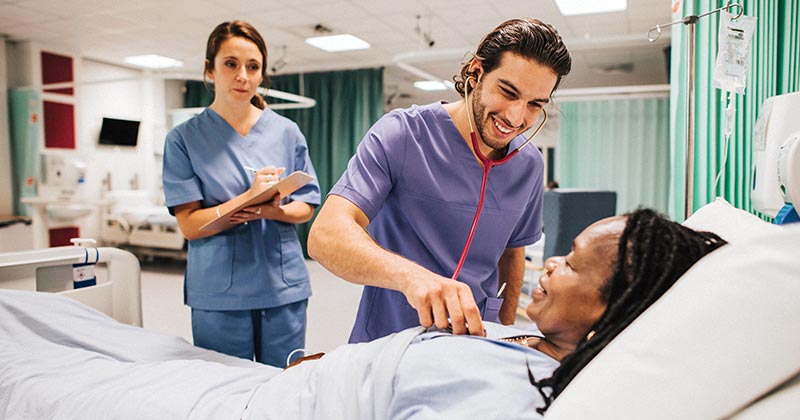
For certain career streams, work placements are required for you to graduate and be admitted to the profession. Trainee nurses have to complete a minimum number of hours working under close supervision in a clinical environment, such as a hospital. Future teachers need to conduct classes in order to demonstrate they have the classroom management and other applied skills needed to work as a certified school teacher.
Clinical psychology, child care / support and law are further career examples where professional accreditation can rely on completing supervised professional training. The placements can be integrated into college programs or be an accreditation requirement after graduation.
Within a college program, training placements for professional accreditation generally happen in final year of a degree. They are the culmination of a student’s academic journey. If you are going to do a vocational degree in such a field, you should be preparing for the placement, and your career to follow, as soon as you make the decision to go in that direction.
3. Undergraduate research
If you’re happy to stay within the network of a school’s campus and faculty, an alternative to an internship is to do undergraduate research. Many degree programs require you to write a dissertation or at least they provide the opportunity to do research instead of traditional coursework.
Research opportunities can range from one units worth of time and effort during a single semester to larger and more involved projects. Larger projects can become significant accomplishments of your college career. If you don’t see any obvious opportunities for undergraduate research at your university, you can always talk to your favorite professors or faculty heads to see if any are willing to set up a research semester or project with you.
Research projects help build skills in your chosen field and in the general application of research practices. They can also prove successful on a larger scale. Thanks to the support networks and tools that colleges provide, many significant breakthroughs in study and scientific process can actually occur at this level. And, although STEM may be the most common image of undergraduate research, it is available in every field of study.
4. Study abroad
Experiential learning doesn’t come much better than immersing yourself in a foreign culture. Travelling to another country even for just a semester can provide a much-needed change in perspective and a break from the monotony of regular classwork. Of course, you can also complete a whole degree in another country as an international student.
Study abroad programs offer all the excitement of a vacation while retaining or even improving the educational content and experience of a university or college course. Even if a trip to Europe or Australia might be outside of your economic reach, you may be able to find financial aid options or fundraising opportunities to make the experience possible.
You can expect to gain personal and professional benefits no matter what. The benefits may be obvious if you field is globally orientated, such as foreign languages or international relations. But you are also likely to grow up quicker and gain new knowledge and perspectives. You’ll also have interesting experiences to include on your CV or resume, content that could potentially help you do strong job interviews when going for graduate positions.
5. Field work and volunteering
On a smaller scale, it’s also possible to get out into your own local community with choices like field work and volunteering. Whether your goal is to get hands-on experience with work in your major or simply to help those in need around you, self-improvement might be only a bus or bike ride away. Other transportation may be required if you doing something outdoorsy such as environmental science or geology.
Considering all that your college town has to offer in these areas can provide more avenues than you expect. Even if nothing grabs your attention, community outreach is a great area to show your own leadership and initiative. You start up or join a new program that accomplishes some good.
6. Simulations, games and role playing
Just about any type of course can incorporate learning exercises where students interact with one another or conduct social experiments. With simulations and role playing, you can step into the shoes of a professional or a client or patient, etc.
- The scenario and reactions of people in a role-play exercise or social experiment can generate the unexpected and require you to think on your feet.
- With games, you find out the winning strategies and likely outcomes from a particular set of circumstances.
These kinds of active learning exercises are fun because they step away from the traditional lecture model and can put you in new and potentially uncomfortable situations. They also ground students in reality better since real interactions can be observed, even if the scenario is purely hypothetical.
Be Open-Minded About the Opportunities
All of the options listed in this article are great things to consider for the college experience, but by no means are they the end-all of experiential learning opportunities. Check university websites, bulletin boards and the Facebook pages of relevant organisations and people. Countless sources are out there to inform you about what’s going on in your college and community.
You might find one of the above opportunities that’s up your alley, or maybe something else entirely that speaks directly to you. Whatever the case, be open minded about the opportunities that college can offer.
A university is much more than a classroom. Making the most of a college experience can also mean taking full advantage of the learning options outside of the lecture theater or tutorial room.

Jason
I did not have the most exciting in person classes when it was my time in college. It was plain ol boring lectures coupled with frequent exams. It was definitely boring and it didn’t excite me. I would definitely support Hands on Experiential learning because the learnings are more practical.
Rick
If you are going to go the route of internships, just be sure you are getting real experience. I know in the US (where I am now, moved here for education), companies will take advantage of unpaid interns and use them for petty tasks anyone can do just so they can work less.
Jorge Castillo
Why can’t you have the best of both worlds? That’s why I have come to appreciate how more colleges and universities are incorporating hands-on and experiential learning into traditional learning environments. Internships have been around for the most part, but opening things up with avenues like role-playing, simulations, field work, etc. are all valuable.
C.C. Hunt
Some people claim that you can’t learn a job in the classroom, but this article shows that classroom instruction (online or in-person) along with hands-on or experiential learning is the way to do things right. In terms of internships, make sure you research whether you’ll have a chance to do any work in the field (under supervision of course) rather than just riding a desk.
James
Hands-on learning should be something every school and University out there uses. We want to help students become solid, knowledgeable individuals that improve society. For this, we need them to learn while they are doing. Theory will only get you so far and a hands-on approach will make sure some lessons are never forgotten. Education must head in this direction and leave behind the classic learning style. Universities that do not adopt experiential learning will soon find themselves without enough students to continue operating.