Are Online Phlebotomy Classes Legit?

Online phlebotomy classes can be legit, but they do not remove the need for supervised blood collection experience. A course may teach theory and assess practice on a training arm but leave you to arrange clinical training elsewhere.
We investigated U.S. course information, NHA certification requirements and student experiences to see when online classes succeed and why some students consider them a scam. Successful accounts paired online study with in-person training. Students who became frustrated often had no confirmed place to complete their blood draws.
Our recommendation is to confirm the clinical training arrangement first, then choose compatible online classes for the theory and exam preparation. Securing both parts before enrolling reduces the risk of paying for coursework you cannot turn into a completed qualification.
What Online Phlebotomy Classes Include
Online phlebotomy training can include academic coursework, practice with a home training kit and instructor assessment. Live blood collection experience is a separate component that may be arranged through the course or left to the student.
| Training component | What online study can provide | Where you attend in person |
|---|---|---|
| Theory and exam preparation | Lessons on anatomy, safety, patient identification, blood collection procedures and specimen handling. | Academic lessons can be completed remotely. |
| Simulated skills practice | A training arm, demonstrations and recorded assessments reviewed by an instructor. | Some courses use home kits; others schedule laboratory sessions. |
| Live blood collection | Course staff may coordinate a clinical site and the required documentation. | Supervised blood draws take place with people at an approved training site or workplace. |
A “100% online” description may refer to the coursework rather than the complete training needed for certification. For example, U.S. Career Institute supplies online lessons and a practice arm but explicitly says students must obtain their live blood collection experience independently.
Secure Clinical Training Before You Enroll
Start by establishing where you will complete supervised blood draws and which courses that site accepts. A convenient online timetable is of little use if you cannot complete the clinical component.
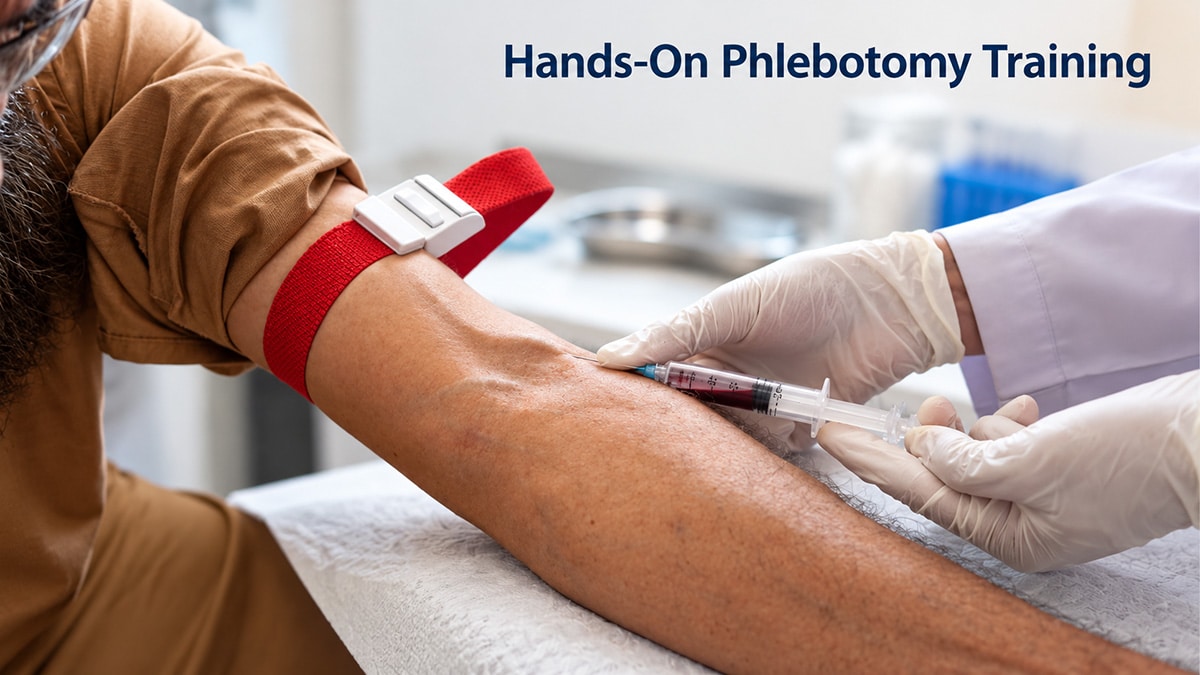
Choose a hybrid course that includes in-person labs and an arranged clinical placement. If you already work in healthcare, ask whether your employer can supervise your blood draws and confirm that the course provider will accept that experience.
Get clear answers about:
- Location and timing. Where will you train, when can you start and what attendance is required?
- Compatibility. Does the course provider accept the clinical site? Is an agreement needed between the school and facility, and who arranges it?
- Supervision and records. Who teaches you, observes your blood draws and confirms that you have completed the required experience?
For NHA certification, candidates need evidence of at least 30 successful venipunctures and 10 capillary or finger sticks on live people, alongside the other eligibility requirements. Practice on a training arm does not count toward those collections.
When Online Phlebotomy Classes Succeed
Online classes succeed when the academic lessons connect to supervised, in-person training. Student accounts illustrate how those components can be combined.
Online modules alongside an in-person course
One graduate used online modules from National Performance Specialists alongside a ten-week in-person course. The student found the modules helpful and later reported getting a job at a Labcorp outpatient facility less than a month after graduation.
Online learning formed part of a combined program that also provided in-person instruction. The reported employment outcome followed that combined training.
A hybrid timetable that includes blood draws
In a March 2026 discussion, another student described completing half the course online and attending in person three days a week. Blood draws were completed during the in-person portion.
For students seeking less classroom attendance, that is a useful model: study some material remotely and attend scheduled sessions for hands-on training. Online delivery reduces attendance for academic lessons while keeping blood collection training in person.
When Online Phlebotomy Classes Fail
Online training fails to deliver a completed qualification when students cannot obtain the required clinical experience. Two student accounts describe coursework followed by a stalled search for somewhere to perform blood draws.
A $1,200 course with no clinical site
A student writing in March 2026 reported finishing an online course but still needing 30 blood draws. School staff said arranging an externship was the student’s responsibility.
According to the post, local hospitals wanted an affiliation agreement, and the school had not been cooperative. After spending $1,200, the student was searching for a way to complete the required experience.
Placement assistance that leaves the search to the student
A July 2025 graduate described completing an ed2go course through a local community college. References to an externship had led the student to expect help from an adviser.
After completing the course, the student learned that they were expected to find a facility and start the process themselves. Calls to nearby hospitals produced transfers and unclear answers, and the student reported postponing the exam.
Both accounts describe unresolved clinical arrangements at the time of posting. College branding and completed online assessments had not solved the problem of finding supervised experience.
Certification Preparation and Practice Tests
Once clinical arrangements are confirmed, check how the online course prepares you for your intended certification exam.
For an NHA-focused course, look for:
- Lessons based on the current Certified Phlebotomy Technician exam test plan.
- Practice questions that explain why an answer is correct.
- Clear information about exam eligibility, fees and any included exam voucher.
Practice questions can show why venipuncture technique matters and reveal gaps in your knowledge of patient care, safety and specimen handling. Review your mistakes, study those topics and then try fresh questions.
Passing an exam and receiving certification can also be separate events. Under the NHA pre-externship option, eligible students can take the exam before finishing the required externship. But certification is withheld until completion is confirmed. Exam preparation does not replace clinical training.
Related: Is the NHA Phlebotomy Exam Hard?
Are Online Phlebotomy Classes Worth It?
Online phlebotomy classes are worth it when they reduce classroom travel and connect to clinical training you can actually attend. A hybrid course or an approved arrangement through an existing employer can provide that combination.
For a beginner without clinical contacts, paying more for a program that arranges supervised experience may offer better value than a cheaper course that leaves the entire search to you. Compare the full cost, including equipment, clinical training and exam fees.
Choose the clinical arrangement first, then select compatible online study. A legitimate provider can teach useful material, but you still need a confirmed way to complete the physical part of the training.